"The Permafrost Dithyrambos ", oil on canvas, 50x40cm. (2011)
This revisitation of the painting "The Permafrost sonnet"
by AFAN Alessandro Fantini will be featured in Charity Show GREEN BLOOD curated by Alexandra Mazzanti & Tara McPherson
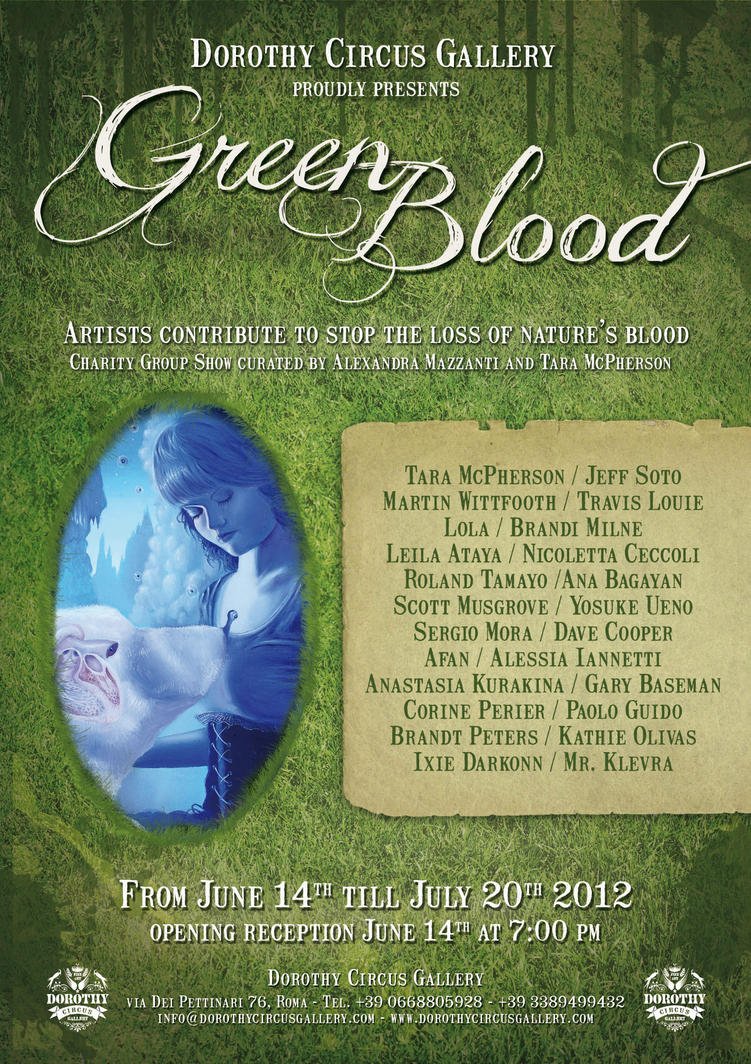
opening on June 14th 2012 at Dorothy Circus Gallery, Rome http://dorothycircusgallery.com/
The upcoming group show at Dorothy Circus Gallery entitled Green Blood, curated by Alexandra Mazzanti and Tara McPherson, opens on June 14th and can be seen through July 20th. This exhibition will be an efflux of surrealistic paintings with a focus on the symbolism of life and nature. Green Blood features a wide variety of talented artists such as Tara McPherson, Jeff Soto, Martin Wittfooth, Travis Louie, Lola, Brandi Milne, Leila Ataya, Nicoletta Ceccoli, Roland Tamayo, Ana Bagayan, Scott Musgrove, Yosuke Ueno, Sergio Mora, Dave Cooper, Paolo Guido, AFan Alessandro Fantini, Alessia Iannetti, Anastasia Kurakina, Gary Baseman, Kathie Olivas, Brandt Peters, Chris Ryniak, Ixie Darkonn, Amanda Spayd, Mr. Klevra and Corine Perier. These artists are exploring mystical doctrines, creation, and how nature continues to be a centralized symbol of life. All artworks and drawings are created for charity and sales will be donated to Greenpeace and Oceana; charities that take care of animals and nature.
Hi*Fructose article: http://hifructose.com/2012/05/24/green-blood-group-show-at-dorothy-circus-gal..." class="external">[link]
"The green blood of nature differs from ours only for an atom, magnesium instead of iron.
Twins of the trees and dependent upon each other. One ancestral link led to the development of the core mystical doctrines concerning the secret aspect of creation.
The tree has always been used as a symbol of life. In the Kabbalah is the program according to which there was the creation of the world, and the path of descent along which the souls and creatures have reached their present form. It is also the path slope, through which the entire creation can return to the goal which we all long: the unity of the "womb of the Creator." "Tree of Life" is the "Jacob's Ladder" (see Genesis 28), whose base is resting on the ground and its top touches the sky. By trees, reminiscent of the ancient blood pact, by the green blood creatures, the artists of the Green Blood are inspired, involving the nature in its entirety and representing its entities through a surrealistic painting."
AFan Alessandro Fantini "I ditirambi del Permafrost - The Permafrost Dithyrambos", detail - oil on canvas, 2011
Poster design by Valentina Antelmi
The
upcoming group show at Dorothy Circus Gallery entitled Green Blood,
curated by Alexandra Mazzanti and Tara McPherson, opens on June 14th and
can be seen through July 20th. This exhibition will be an efflux of
surrealistic paintings with a focus on the symbolism of life and nature.
Green Blood features a wide variety of talented artists such as Tara
McPherson, Jeff Soto, Martin Wittfooth, Travis Louie, Lola, Brandi
Milne, Leila Ataya, Nicoletta Ceccoli, Roland Tamayo, Ana Bagayan, Scott
Musgrove, Yosuke Ueno, Sergio Mora, Dave Cooper, Paolo Guido, AFan
Alessandro Fantini, Alessia Iannetti, Anastasia Kurakina, Gary Baseman,
Kathie Olivas, Brandt Peters, Chris Ryniak, Ixie Darkonn, Amanda Spayd,
Mr. Klevra and Corine Perier. These artists are exploring mystical
doctrines, creation, and how nature continues to be a centralized symbol
of life. All artworks and drawings are created for charity and sales
will be donated to Greenpeace and Oceana; charities that take care of
animals and nature.
"The Permafrost dithyrambos" (2011) by AFAN Alessandro Fantini featured in Charity Show GREEN BLOOD curated by Alexandra Mazzanti & Tara McPherson opening on June 14th 2012 at Dorothy Circus Gallery, Rome http://www.dorothycircusgallery.com/
As the majority of people I’ve often experienced that peculiar phenomena called “Déjà vu”, that is when a situation, place or a scene actually happening or manifesting itself for the first time seems to be the perfect as well as ominous replica of something we’ve already seen or lived before. As far as I can remember that perception was very recurrent over my childhood. Sometime its intensity was so enveloping and insidious that more than once I was about to believe that this feeling was the proof I lived one or many more previous existences. In my case it happened mostly when I was alone in the open countryside, just surrounded by the vibrant silence of the twilight, or when I was inside an old building like that one of my grandparents . I still vividly remember how I was entranced by studying the penumbra descending over the dizzy staircase leading to the bedroom like a bridge built among two distant temporal dimensions. My fear of falling while climbing it was so strictly tied to my enthrallment for its majestic and ancient weirdness, that the sense of having already been there centuries ago (and not just physically) became a sort of sadomasochistic rapture. The occurrence of such ideas easily melted with my dreamlike activities, enhancing my sense of dislocation and creepy longing since I couldn’t establish the right amount of fantasy (or dreamed memories) generating my particular “déjà vu” experiences.
Soon this mood evolved in a deeper state of mind that engulfed my imagination pushing me to find a way to free myself from the overgrowing sense of eeriness by giving them a plastic interpretation.
Since I was 4 years old, drawing was the most direct process of draining my kaleidoscopic entanglement of uncanny emotions. When I learned writing I had the chance to try decrypting that aura of mystery through the evocative use of words. Nevertheless, I slowly realized that both narrative and poetic writing were limited by a rational cage of rules and structures unable to fully preserve the same quality of magical enigma owned by other less exclusive codes like music or cinema. Even radical experiments like those of James Joyce who tried to replicate the “stream of consciousness” erasing the punctuation and syntax, or Guillame Apollinaire who conceived the “calligrammes” in order to graphically enhance the lyrical power of words, looked like too much ingenious attempts to imitate the same spontaneous poignancy of the visual or musical arts. Consequently the will of approaching the art of painting marked a third step in my personal quest to translate what Freud called “unheimliche”. Indeed it was around my early adolescence, when I was managing to acquaint myself with the canvas and the brushes, that I started to analyze a more subtle shade in my own sentiment. Actually the illusory perception of forethought contained inside the psychic delight of the “déjà vu” revealed to be the source of a more complex tension linked to the bewitching nature of a cosmic truth hidden behind simple circumstances or images. While I was keeping working on my feverish painting expeditions , I progressively began to seek this new intuition into cinema and video art, whose grammar of lively mysteries seem to be closer to the perfect rendition of that delicate and powerful emotion of an impending revelation evolving in space and time.
Although so far I dedicated myself to writing, directing movies and music videos and composing music, I still consider painting my most intimate dominion where pursuing the evocation of what I like to define “mysterium interruptum”, “a suspended mystery”, that is something very similar to the experience of the “presque vu”, “almost seen”, when we feel that we’re about to recall a name or a word without being able to tell it. In fact like the more sensual “coitus interrupts”, the pleasure of this impression relies on the anguished awareness of the unspeakable that only the crystallization of momentum rendered by a painting can deliver to the watcher, whereas art forms like cinema and music manifesting themselves in time tend to dissolve this “frozen arousal” into their dynamic volatility. Thus I can say that my best paintings, most of them collected in this book, are somehow the aural secretion of the loop between the “déjà vu” and the “presque vu”.
One of the most meaningful release of this “circuit” has been the painting entitled “The breath of William Kurelek”.
The story of my obsession for the painter Kurelek dated to the discovery of his masterwork "The Maze" that happened accidentally when I was a child reading a large book about psychiatry belonging to a friend of my father. The detailed and disturbing sagittal representation of a human skull full of boxes containing small iconic scenes (reminiscent of those ones depicted by Magritte, Ernst and Dali) impressed me so deeply that I couldn't forget it for a long while, even if I wasn't able to know who was the painter since the book didn't provide the name of the author. The mystery enveloping both the painting theme and its creator boosted even more my fascination for the image. Somehow his Bosh-like and bruegelesque taste reminded me an intense state of mind I perceived when I was very young staring at the little figures on the basement of an old globe in my house. But when I checked that basement I discovered that those figures never existed.
Accidentally many years later I found again the same large book in the house of a friend of mine, and this time I was tormented by the gloomy urgency of a truth hidden behind that image. I checked out the illustration references at the end of the volume and, following the several clues on the web, I finally managed to find his name. Since then I studied his life reading rare Canadian books and discovered further impressive pictures and drawings he made during the period he spent at the London Maudsley Hospital when he was hospitalized for his depression and painted "The Maze". I started to paint a medieval urban landscape while I was simply musing about all the ancient feelings I recovered when I found again that gruesome Kurelek's self-portrait. Even though I cannot explain why I paint it, I think that showing what you cannot express through words and logic, or that is "on-tip-of-the tongue", might be the reason paintings are made for.
Sci fi thriller EDONISM directed by Alessandro Fantini and produced by Lorenzo Fantini and WALKING LOST by LAFAN Productions will screen at the Good Rapport Film Festival in Tokyo.
Screening times: 4:30pm Saturday, 7 April and 9:30am Sunday, 8 April.
For access map/ticketing information visit the festival website: http://goodrapport.rionne.com/schedule.html
James came to Tokyo looking for the dream and a life with his beautiful wife, Sophie. Instead he found a life of toil, torment and alcoholism. Unable to face his descent into self destruction, Sophie left, abandoning him to his downward spiral into the gutter.
When things can't get any worse, his grip on reality is stolen from under him as he experiences all manner of hallucinations and ulitmately a coma.
When he is revived he begins to learn some terrifying truths about his condition and his connection to a long forgotten legend from ancient Japan.
Together with the resourceful Dr Geena Landlord he attempts a desperate quest of discovery that leads them both to the very heart of conspiracy involving a secret government order and the enigmatic being known as the The Cat Fish .
Presented by Chashama, Produced by Artists Wanted.
"We will be taking over a slew of the most iconic video billboards in Times Square to create the largest exhibition of art in New York City".
I've always dreamt about displaying my visions on vidwalls or on the skyscrapers and buildings facades since most of their subject refers to the swarming life of polymorphic metropolis nurtured and moulded by the irrational feedabcks of their inhabitants, like a mucilagenous brain pulsating inside an ever-changing hive made of cells full of fears and desires.
My portfolio needs to be collected 7 times in order to be viewable in the public judging, so spread the word and support my submission by clicking "collect" [link]